
The video game industry is probably the most curious sector in the world of entertainment. A medium that despite its youth, just over fifty years old, has not only suffered a savage crisis, the Atari debacle in 1983, but has also managed to overcome it to become the most profitable branch of popular entertainment. In 2022, the video game sector had a turnover of over one hundred and seventy billion euros, surpassing the profits of the film and record markets combined. A particularly commendable figure considering that in their origins these little games were niche products, distractions for those who glimpsed universes into which to venture by observing handfuls of crude pixels.
It didn’t take long for the wise to realize that this emerging gaming market was a new showcase format for big business. In 1983, Coca-Cola’s creatives came up with the idea of giving away one hundred and twenty-five mysterious Atari cartridges to attendees at a sales meeting. Inside the circuits of each of those gifts was a video game that was never commercially released, but became a legend: Pepsi invaders. A version of the classic Space invaders in which a Coca-Cola can shot down several rows of threatening letters that spelled out the name of the rival company.
Eventually, it became clear that the medium was friendly to all sorts of advertising gimmicks. In 1992, a platformer called Zool landed on Amiga computers with the sincere intention of taking on Sega’s Sonic himself. And it was presented embracing product placement without blushes, sponsored by some Chupa-chups whose omnipresence dotted the initial scenarios, those levels that players, however clumsy they were, would contemplate more often. Gradually, many other games would try their hand at sponsorship by devising new marketing techniques, including advergaming, the idea of building a game around a brand. Under this premise, the McDonald’s emporium produced M.C. Kids on NES or Global gladiators and McDonald’s treasure land on Megadrive, platform games, the fashion in the eighties and nineties, where the plots, items, scenarios and even the main characters were made from elements of the restaurant chain. In the meantime, 7-Up had the nice idea of taking the logo of the soft drink, and removing the red dot from it to turn it into a charismatic console hero. A cool red badge that would star in its own saga through numerous machines and generations: Cool spot, Spot goes to Hollywood or Spot: the cool adventure. A good part of these advergames of the nineties stood out for not being minor creations, but releases with remarkable production values, conceived by renowned programmers. In these cases, the public bought and enjoyed cartridges that were impeccable advertising vehicles for the company.
By the end of the second decade of the twenties, the medium had already tried every imaginable branch of promotional marketing. Real sportswear on the kits of FIFA players, billboard ads that dynamically modified their content on the highways of Burnout paradise or the battlefields of Mercenaries 2, video spots inserted into free-to-play mobile games, and even gigantic worldwide events of artists and franchises held on the lands of Fortnite or the seas of Sea of thieves. But another type of unexpected strategy was yet to appear on the scene: dystopian marketing.
In 2019, after four years of development and with a budget that Forbes magazine estimated at between sixty and eighty million dollars, Death stranding was officially launched. An adventure set in a dystopian future and conceived by the legendary cult author Hideo Kojima, creator of the Metal gear saga and a friend of taking risks with crazy ideas. His Death stranding had the soul and ambitions of a blockbuster: a cast with names such as Norman Reedus (The Walking Dead), Léa Seydoux (Life of Adele), Mads Mikkelsen (Hannibal), Margaret Qualley (Once Upon a Time in Hollywood), Guillermo del Toro (director of Pan’s Labyrinth), Nicolas Winding Refn (responsible for Drive) or Edgar Wright (creator of Shaun of the Dead); a soundtrack with songs by Low roar, Chvrches, Bring me the horizon or Major lazer; a plot that was jealously kept secret until the last moment, and about forty hours, at least, of gameplay ahead.
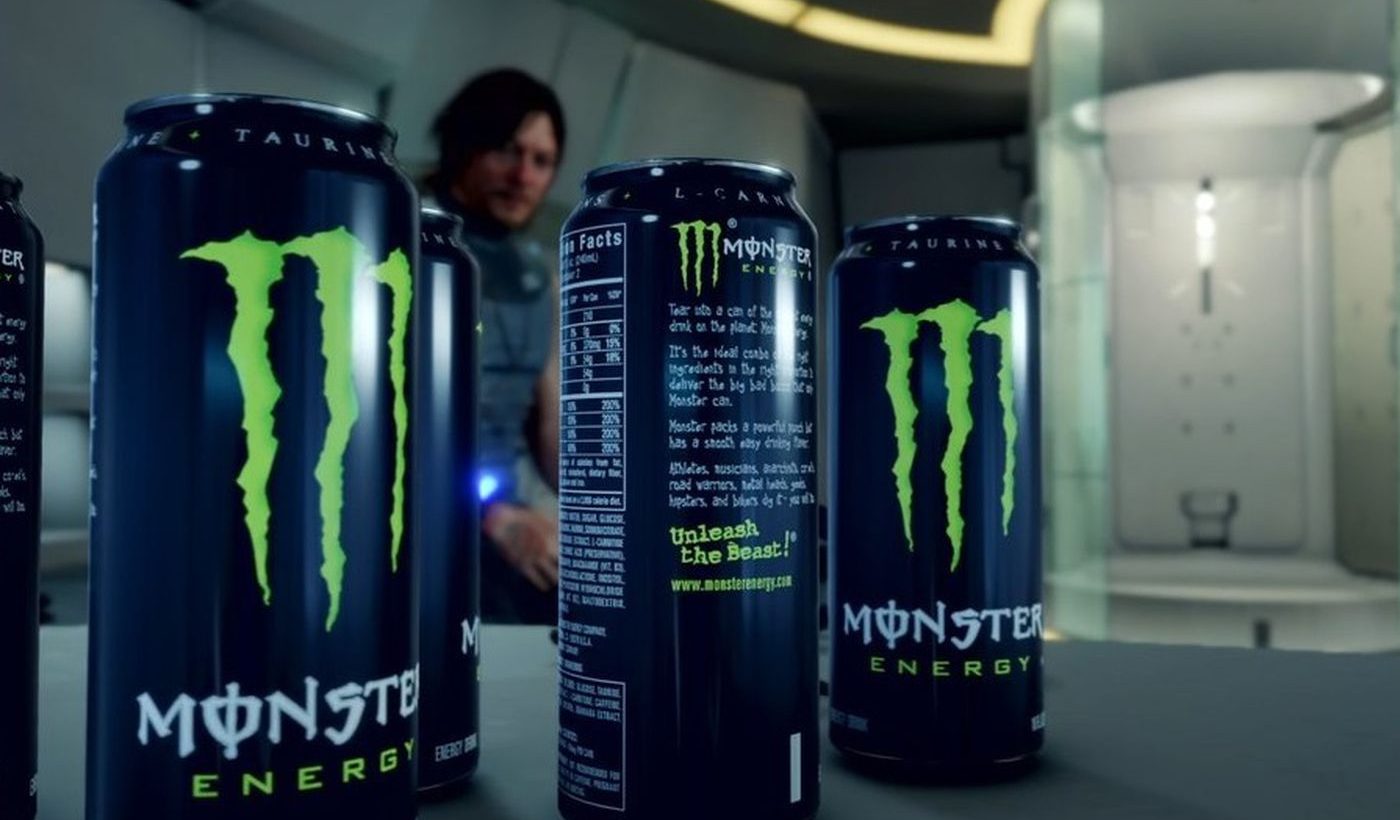
Death stranding also premiered accompanied by an unexpected advertising juggling act. A commercial alliance between Kojima and Monster energy drink for the latter to enter the universe of the former. In the adventure, the protagonist of the story (Reedus) not only drank cans of Monster but also carried its merchandising. In practice, the concoction was not a mere aesthetic element but an active part of the game, because gulps of booze temporarily increased the character’s stamina. On the other side of the screen, players questioned the publicity stunt citing dissonance, because in the context of a post-apocalyptic story, the presence of a multinational beverage company in our world seemed strange to them. On paper, Death Stranding garnered critical praise as it climbed the sales charts. And the much-talked-about product placement controversy finally paid off: after the game’s release, the value of Monster’s stock soared to peaks it hadn’t reached in weeks.
Ultimately, that dystopian marketing precedent would spawn a curious disciple. In 2020, Cyberpunk 2077 hit the stores, eight years after its first official announcement. It was a highly anticipated video game, set in another dystopian future where Keanu Reeves played the co-starring role. A product of costly development, almost two hundred million dollars, and a colossal previous promotional campaign. And also a work that, unfortunately, would become one of the most catastrophic releases in the history of entertainment: it was released unfinished, full of bugs and problems that forced to withdraw copies in circulation and return the money to consumers. The interesting thing is that, before the disaster, the game was also the subject of an advertising quip that evoked Death stranding’s caffeine, but in reverse. Because its managers reached an agreement with the company Rockstar energy to manufacture in the real world an energy drink, called Samurai cola, conceived as part of the Cyberpunk 2077 universe. In fact, taurine-based product placement was not the only link with Death Stranding that this cybernetic future possessed: in one of the adventure’s missions, players could visit the pub of a luxurious hotel, and find a man with the look of a cult author, and the same physiognomy as that Japanese man named Hideo Kojima, among its armchairs. The visionary inventor of dystopian marketing.


